


Welcome to this week’s episode of The Mindbridge Podcast: Where Science Meets Human Rights! This podcast invites human rights defenders to teach and learn from brain and behavioral scientists about how we can all use science to do human rights work that is more efficient and impactful.
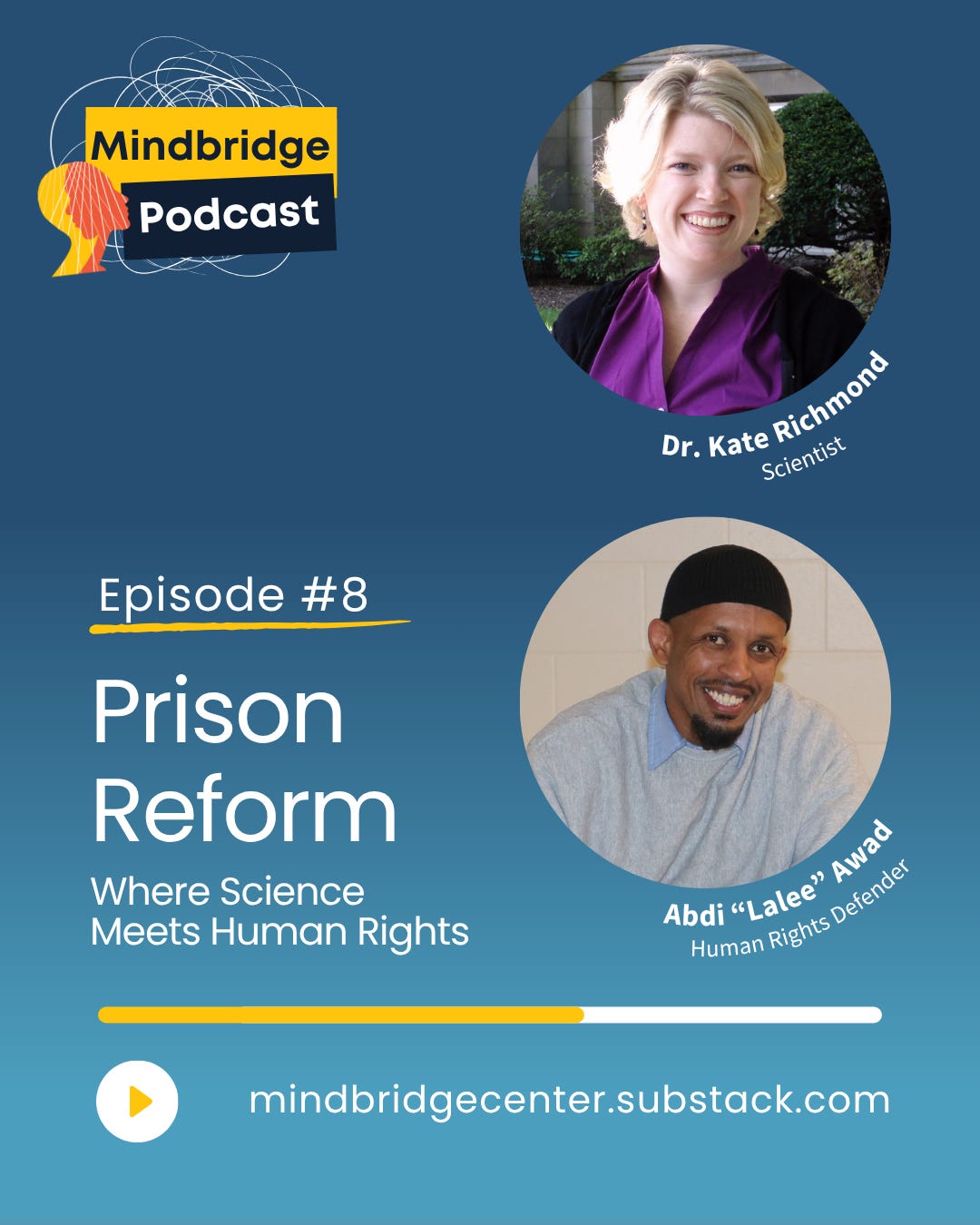
Today, we are joined by Dr. Kate Richmond and Abdi “Lalee” Awad to discuss the topic of prison reform!
As we take some much-needed time for rest and renewal for the new year ahead, we honor all those working for justice, equity, and human rights around the world. Our team looks forward to bringing you more podcast episodes and written articles in January!
DR. KATE RICHMOND, PhD., is Professor of Psychology at Muhlenberg College. She is widely published in the areas of multicultural psychology, gender ideology, masculinity, and trauma. Her co-author undergraduate textbook, entitled Psychology of Women & Gender was awarded the 2020 Distinguished Publication Award by the Association of Women in Psychology. Dr. Richmond has been nationally recognized on several occasions for excellence in teaching, facilitation, and mentorship, including being the recipient of the Florence Denmark Distinguished Mentoring Award and the Paul C. Empie Memorial Award for Excellence in Teaching.
She is passionate about community-based organizing and most recently, has worked within the Lehigh County Corrections facility and is a former member of the SCI-Graterford Prison Think Tank. Dr. Richmond works alongside individuals who are currently or formerly incarcerated, to increase access to higher education, reduce mass incarceration, and build healthy communities. Dr. Richmond is also a licensed psychologist and maintains a private practice in Philadelphia, PA. She is also a consultant for Kaleel Jamison Consulting Group, a firm that specializes in organizational cultural change.
ABDI “LALEE” AWAD (MS) is an advocate with many hats; he has consulted on and facilitated culturally responsive restorative practices, co-authoring and consulting on restorative justice-based policies. His previous work includes being a Senior Justice Scholar with Opportunity Scholars as advocate for access to higher education and employment of incarcerated and formerly incarcerated individuals, a 2023 UCLA Dream Fellow, and an Alliance for Higher Education 2024-2025 fellow. His current work includes serving as Mindbridge’s Healing Racial Trauma Community Circle Facilitator and consultant, program development guide, Restorative Practices/Justice co-facilitator, and mentor for the dee Clarke Justice Fellowship program (dCJF) with the place matters team under the University of Southern Maine’s Catherine Cutler Institute. He approaches his work through the lenses of intersectionality and systems thinking.
Lalee holds a Master’s degree in Adult and Higher Education from the University of Southern Maine, where he is currently a PhD student in their Leadership program. He is someone who is directly impacted by the legal system (presently incarcerated) and refuses to let his circumstances define him. He is a Certified Hospice and Palliative Care Volunteer and has completed 500-hours of yoga teacher training. As an advocate, Lalee draws on his experiences as an immigrant (from Somalia) and someone impacted by the justice system to drive change.
He has a history of mentoring youth and young adults through restorative practices and is passionate about uplifting and empowering the voices of young people and underserved communities. Outside of work and advocacy, Lalee enjoys reading/writing poetry, as well as watching documentaries. He is someone who continually seeks to learn and connect with the world.
Mindbridge is the nation’s leading non-profit using brain and behavioral science to empower human rights defenders.
We conduct programming, support partnerships, and direct research at the intersection of psychological science and human rights. Through these efforts, Mindbridge is growing a science-driven community that gives human rights defenders access to the hearts and minds of those they serve.
To learn more about how we use brain and behavioral science to empower human rights defenders, find us at mindbridgecenter.org, read our blog on Psychology Today, and follow us on social media.
Instagram: Mindbridge_Center
Facebook: Mindbridge Center
LinkedIn: The Mindbridge Center
BlueSky: MindbridgeCenter


