

Welcome to this week’s episode of The Mindbridge Podcast: Where Science Meets Human Rights! This podcast invites human rights defenders to teach and learn from brain and behavioral scientists about how we can all use science to do human rights work that is more efficient and impactful.
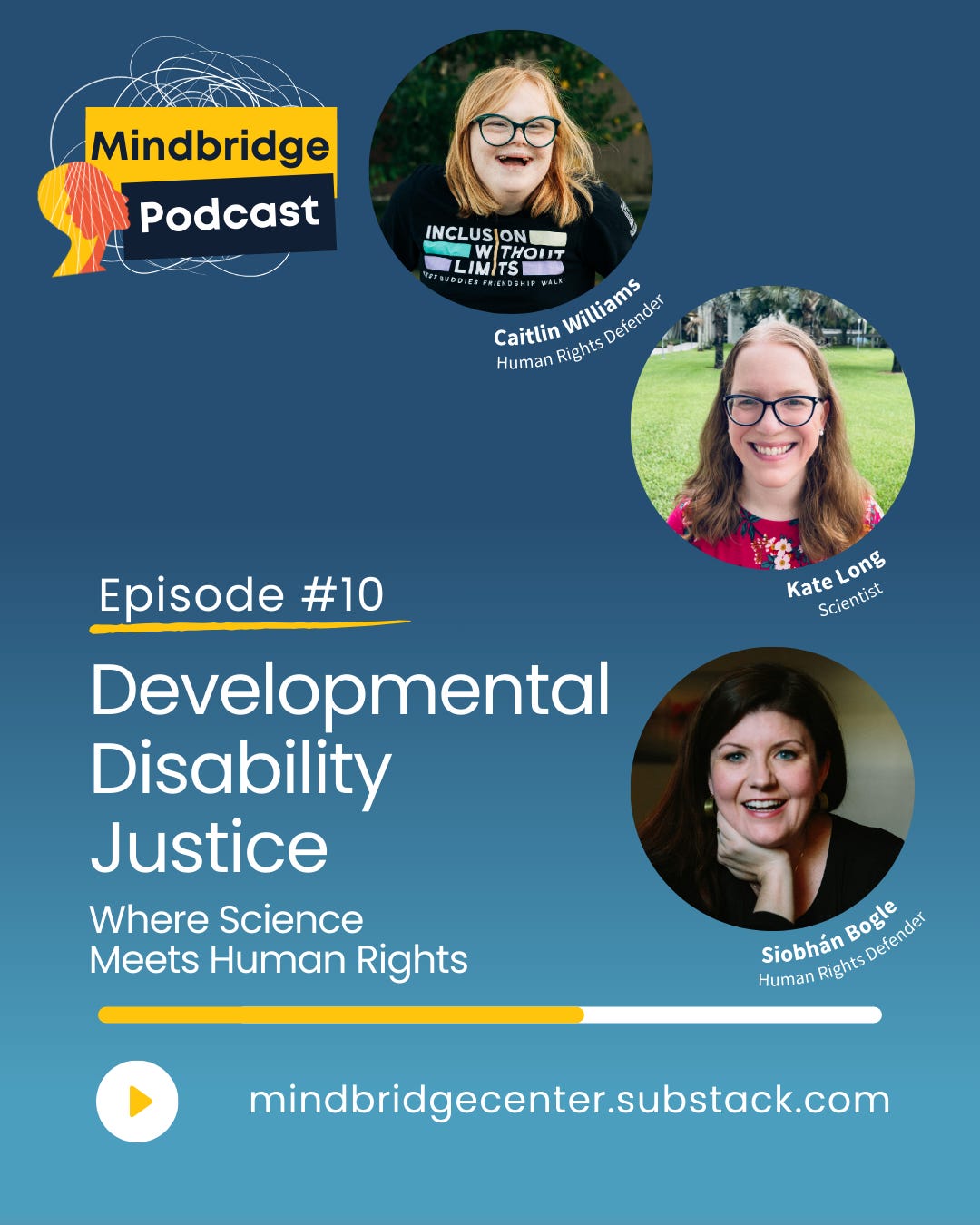
Today, we are joined by Caitlin Williams, Kate Long, and Siobhán Bogle to discuss developmental disability justice!
CAITLIN WILLIAMS is a 21 year-old young adult who has Down Syndrome. She has a large family, including a twin brother, two sisters, another brother and four dogs. She loves having a big family and always has something to do! She loves swimming, she’s part of an adaptive cheering squad and also loves going to the gym with friends. She loves loud music, movies, bowling and the arcade. She is part of best buddies in Maine and loves connecting with other people who have IDD. She lives in her own apartment and hopes to someday work at an animal rescue.
KATE LONG is a Ph.D. candidate in developmental science at Florida International University where her work has focused on centering the voices of people with intellectual disabilities and their families. She has been a licensed occupational therapist for nearly 10 years, and has clinical experience serving people with disabilities in schools, hospitals, and mental health service centers. Before becoming an occupational therapist, she was a Direct Support Professional supporting adults with intellectual disabilities, a role which has profoundly shaped her orientation towards disability justice.
SIOBHÁN BOGLE is a dedicated special education teacher, connection seeker, and inclusion advocate who believes deeply in the power of relationships to transform learning. With a masters degree in Special education and concentration on Inclusion education, she has a passion for neurodiversity-affirming practice, she works to create classrooms where every student is seen, valued, and supported as their full self. Siobhán is committed to building inclusive school communities, strengthening collaboration among educators and families, and elevating the lived experiences of individuals with disabilities. Her work centers compassion, dignity, and authentic connection both inside the classroom and in the broader world.
Mindbridge is the nation’s leading non-profit using brain and behavioral science to empower human rights defenders.
We conduct programming, support partnerships, and direct research at the intersection of psychological science and human rights. Through these efforts, Mindbridge is growing a science-driven community that gives human rights defenders access to the hearts and minds of those they serve.
To learn more about how we use brain and behavioral science to empower human rights defenders, find us at mindbridgecenter.org, read our blog on Psychology Today, and follow us on social media.
Instagram: Mindbridge_Center
Facebook: Mindbridge Center
LinkedIn: The Mindbridge Center
BlueSky: MindbridgeCenter


