

Welcome to this week’s episode of The Mindbridge Podcast: Where Science Meets Human Rights! This podcast invites human rights defenders to teach and learn from brain and behavioral scientists about how we can all use science to do human rights work that is more efficient and impactful.
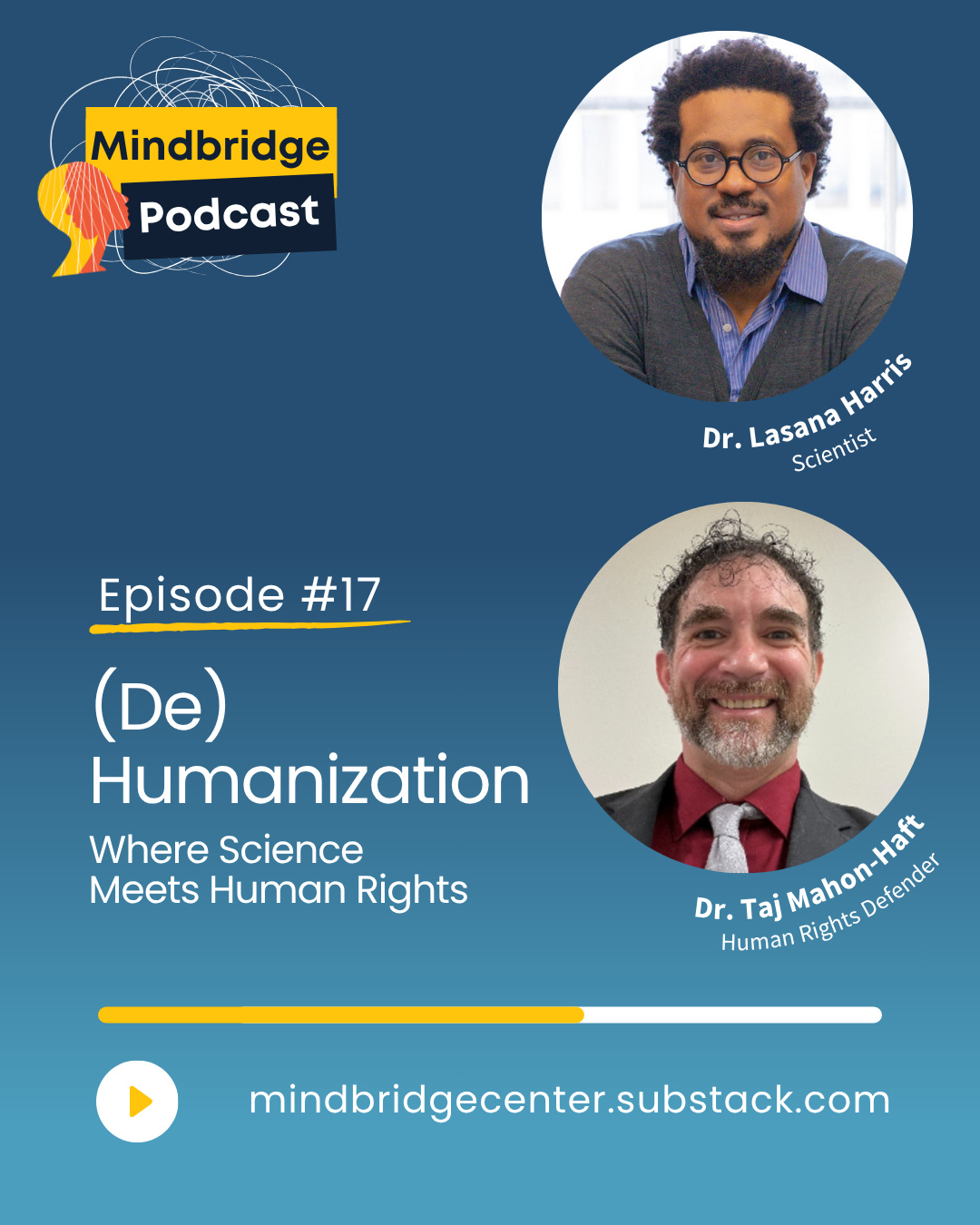
Today, we are joined by Dr. Lasana Harris and Dr. Taj Mahon-Haft to discuss the psychology behind dehumanization, its lasting implications, and how we can shift toward humanization instead.
LASANA T. HARRIS, Ph.D. is appointed in the Department of Experimental Psychology at University College London (UCL), where he is the Vice Dean for Global Engagement in the Faculty of Brain Sciences (FBS).
Prof. Harris is a social neuroscientist who takes an interdisciplinary approach to understand human behaviour. His research explores the brain and physiological correlates of person perception, social learning, emotions, social inferences, stereotyping, dehumanization, anthropomorphism, punishment, and decision-making. His research addresses questions such as: How do we see people as less than human, and non-human objects like AI, institutions and animals as human beings? How do we modulate affective responses to people? How do we make social, legal, ethical, and economic decisions?
The work in his Boundaries of Social Cognition lab covers a wide range of disciplines beyond social neuroscience, including social, cognitive, developmental, comparative and legal psychology, philosophy of mind, behavioural economics and policy.
He has served on Council at the Economic and Social Research Council (ESRC), and consulted with the Office of National Statistics, the UK Government Office for Science, as well as the National Security Institute, United States. He has also consulted with the Nuremberg Academy, The US Institute for Peace, and the Berghof Foundation on Hate Speech and Peacemaking.
Finally, he has consulted with various companies, including Unilever, MindGym, and Channel 4. He has served as an Associate Editor at Psychological Science, the Journal of Experimental Social Psychology, and Affective Science, and is currently on the Editorial Committee of the Annual Review of Psychology. He is a Consulting Editor for the Interpersonal Relations and Group Processes section of the Journal of Personality and Social Psychology and sits on the Editorial Board of the European Review of Social Psychology.
He completed his undergraduate education at Howard University, and received post-graduate training at Princeton University. He has held positions at New York University, Duke University, and Leiden University (Netherlands) before coming to UCL. He has also been a Visiting Professor at the Institute of Philosophy, School of Advanced Study, and a University Fellow at the Turing Institute for Data Science and AI.
He has thus far written one textbook, Invisible Mind: Flexible Social Cognition and Dehumanization, published by MIT Press.
DR. TAJ MAHON-HAFT is the Director and Cofounder of the Humanization Project. Taj is above all a drop-everything father, son, partner, eldest brother, and friend, as well as an avid hiker. Serving also as Director of The Humanization Project is tailored for Taj Mahon-Haft’s training, experience, and passion.
Applying his sociology doctorate (Wash. St. U.) and personal understanding, he is devoted to elevating justice impacted voices to guide systemic change at the intersection of evidence-based policy and tangible lived experience. He has brought humanizing perspectives about justice across Virginia and beyond in legislative, research, educational, and organizing capacities, always centering the lived experience of the countless wonderful people whose lives have been shaped by the weight of doing time. Beyond THP, he currently serves on the Virginia Coalition Against Solitary, Expungement Council, New River Valley Reentry Council, Fines & Fees Advisory Board, and Restorative Justice Legislative Coalition. He has also published about practices of leaders behind bars, parents behind bars, drug policy, inequalities in the criminal legal system, drug courts, and survey methodology.
Before pursuing advocacy full-time, he was an award-winning educator, a mindset that continues to shape his work. He has also served time, lived experience that drives and shapes his work always, for his loved ones so impacted by his carceral journey and everyone still inside or suffering that trauma.
Mindbridge is the nation’s leading non-profit using brain and behavioral science to empower human rights defenders.
We conduct programming, support partnerships, and direct research at the intersection of psychological science and human rights. Through these efforts, Mindbridge is growing a science-driven community that gives human rights defenders access to the hearts and minds of those they serve.
To learn more about how we use brain and behavioral science to empower human rights defenders, find us at mindbridgecenter.org, read our blog on Psychology Today, and follow us on social media.
Instagram: Mindbridge_Center
Facebook: Mindbridge Center
LinkedIn: The Mindbridge Center
BlueSky: MindbridgeCenter


